Decoding Food Labels: Your 30-second Food Label Decoder
Imagine yourself standing in a supermarket, holding a box that screams “Natural!” in bold green letters.. It sounds healthy, so you consider tossing it in your cart. But when you flip it over, you’re met with a confusing grid of numbers, percentages, and ingredients you can’t pronounce. Sound familiar? You’re not alone.
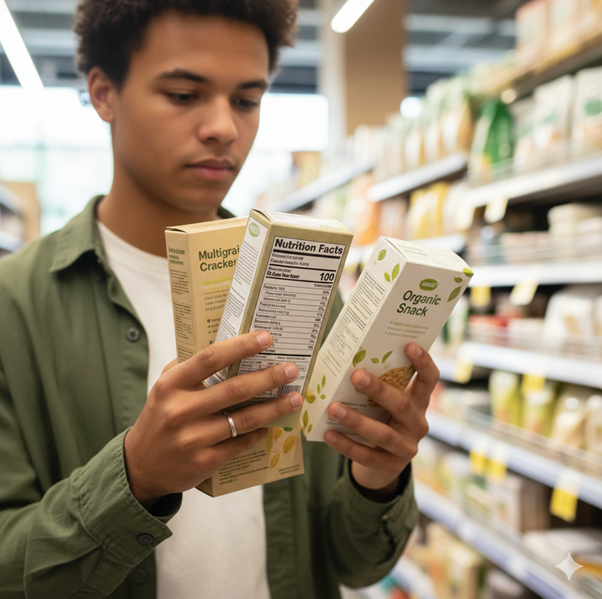
Imagine yourself standing in a supermarket, holding a box that screams “Natural!” in bold green letters.. It sounds healthy, so you consider tossing it in your cart. But when you flip it over, you’re met with a confusing grid of numbers, percentages, and ingredients you can’t pronounce. Sound familiar? You’re not alone.
That innocent-looking package might be hiding more sugar than three Oreo cookies, but you’d never know without cracking the code. Most of us spend less than six seconds scanning a label, falling for the flashy claims on the front while missing the real story on the back.
This guide will change that. It’s not about becoming a nutrition expert; it’s about taking back control of what you eat.
Here is what you need to know, Recommended Dietary Allowance.
FSSAI RDA Standards (India):
Energy: 2000 kcal/day
Fat: 67 grams/day
Saturated Fat: 22 grams/day
Trans Fat: 2 grams/day (maximum)
Added Sugar: 50 grams/day
Sodium: 2000 mg/day
Calorie Breakdown:
Carbohydrates: 4 kcal/g
Protein: 4 kcal/g
Fat: 9 kcal/g
Alcohol: 7 kcal/g
Now you need to think how much of the daily food will make up to 2000 calories?
Why this matters more than you think
Every single day, we make dozens of choices. But here’s what’s shocking — most of us spend less than 6 seconds scanning a label, focusing only on the flashy front-pack claims — ‘Natural’, ‘Herbal’, ‘Organic’; while missing the real story on the back. And that’s exactly what food manufacturers are counting on.
Understanding food labels isn’t about becoming a nutrition obsessive. It’s about not being fooled. It’s about taking back control of what actually goes into your body.
The sneakiest trick that you keep falling for: serving size.
See those “only 100 calories!” claims? Plot twist: that tiny juice bottle you just chugged contained 2.5 servings. You didn’t just consume 100 calories; you downed 250. The math was hiding in plain sight.
So, the serving size changes everything.
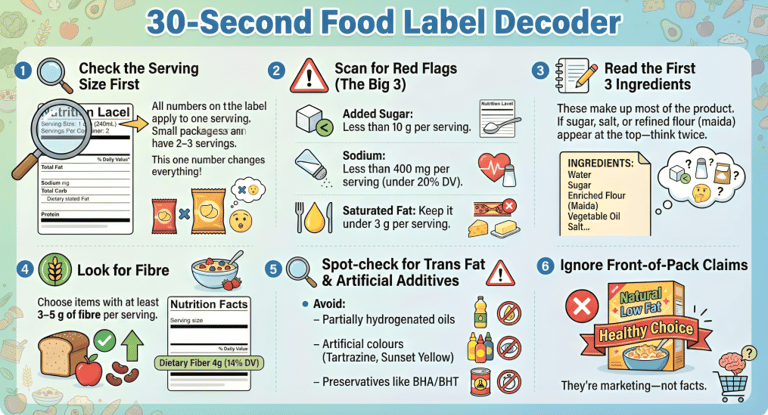
Your 30-second Food Label Decoder:
Remember: Check the serving size.
Serving Size
Big 3 (Added Sugar, Sodium, Saturated Fat)
First 3 ingredients makes up most of the food
Look for fibre (3-5g)
Check for trans-fat and artificial additives
Ignore Front-of-Pack claims!!!
Red Flag Checklist:
❌ Ingredients list is longer than 15 items
❌ You can’t pronounce half the ingredients
❌ Sugar (by any name) in the first 3 ingredients
❌ Multiple types of sugar throughout the list
❌ Trans-fat >0g or “partially hydrogenated oil” listed
❌ Sodium >600mg per serving
❌ “Natural flavours” (could mean anything)
Green Flag Checklist:
✅ Ingredients list is short (<10 items)
✅ You recognize every ingredient
✅ High in fiber (>5g per serving)
✅ Low in added sugar (<5g per serving)
✅ Whole grain is the FIRST ingredient
✅ No artificial colors or preservatives
India-specific alert:
If you see “partially hydrogenated oil” in ingredients, it contains trans-fat — even if the label says “0g trans-fat.” FSSAI allows this if it’s under 0.5g per serving. Your arteries don’t care about technicalities.
Want to be a pro? Check out the next part.