
Decoding The Food Label: A Deeper Dive
A deeper dive to decoding your food label
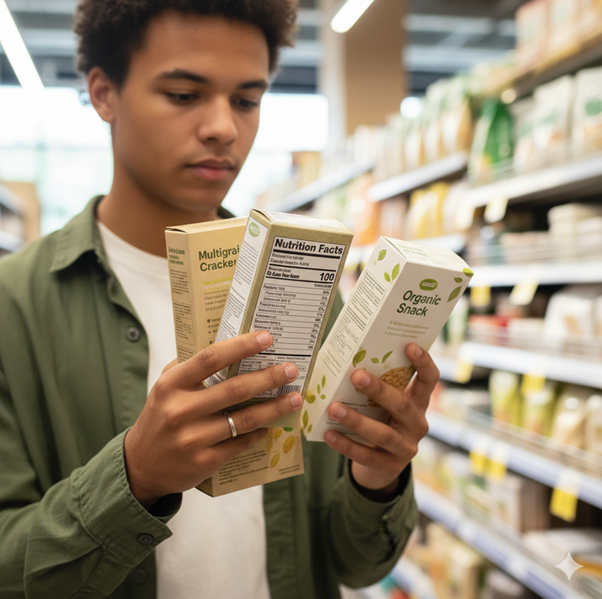
An innocent looking package might be hiding more sugar than most of the things which we consider as “unhealthy”.
I hope you read the “30-second Food Label Decoder”. If not, read it.
Ready to become a pro at decoding food labels? Let’s begin.
Serving Size: The Sneakiest Trick in the Book
Manufacturers often use unrealistically small serving sizes to make the numbers look better. That “100-calorie” drink you just finished? It might have contained 2.5 servings, meaning you actually consumed 250 calories.
Pro Tip: Always check “servings per container” first and do the math.
Calories: Your Energy Snapshot
Calories measure the energy you get from a serving of food. According to the Food Safety and Standards Authority of India (FSSAI), the average adult needs about 2000 kcal per day.
Quick Rule:
Low: Under 100 kcal per serving
Moderate: 100–400 kcal per serving
High: Over 400 kcal per serving
Macronutrients: The Building Blocks
Carbohydrates: This section includes total carbs, fibre, and sugars. Focus on Dietary Fibre (aim for 25–30g daily) and keep Added Sugars as low as possible. The FSSAI recommends a maximum of 50 grams of added sugar per day.
Protein: Essential for muscles and hormones. A product marketed as “protein-rich” should have at least 5–10g per serving.
Fats: Not all fats are bad! The ones to limit are:
Saturated Fat: Limit to 22g per day.
Trans Fat: The worst kind. The FSSAI limit is 2g per day for 2000-calorie daily energy intake, but you should aim for 0g.
The Trans-Fat Loophole in India
India-specific alert: If a product contains “partially hydrogenated oil” in its ingredients, it has trans-fat, even if the label says “0g trans-fat.” FSSAI allows this if the amount is under 0.5g per serving, but even small amounts can be harmful.
Micronutrients & % Daily Value (%DV)
This section shows vitamins and minerals. The %DV tells you how much a nutrient in one serving contributes to your total daily diet.
<5% DV is low.
10–19% DV is a good source.
≥20% DV is high.
This is great for nutrients you want more of (like fiber and vitamins) and for those you want less of (like sodium and saturated fat).
Certifications in India
ISO certifications: Quality management
Jaivik Bharat (Organic India): Certified organic
Agmark: Agricultural quality standards
BIS (Bureau of Indian Standards): For specific product categories
Misleading Health Claims
Front-of-pack claims are marketing, not facts. Here’s what they really mean:
“Made with Whole Grains”: This could mean 99% refined flour and only 1% whole grain. Look for “100% Whole Grain” or ensure whole grain is the very first ingredient.
“Low-Fat” or “Fat-Free”: These products are often loaded with extra sugar to make them taste good, sometimes making them less healthy than the original version.
“No Added Sugar”: Be careful! This can mean the product contains artificial sweeteners. A 2023 WHO advisory recommends against using these for weight control, citing potential long-term health risks.
“Organic”: This refers to the farming method, not the nutritional content. Organic cookies are still cookies. For certified products in India, look for the Jaivik Bharat logo.
Sugar’s Disguises
Sugar hides under 60+ names on ingredient lists:
Common aliases:
Glucose, fructose, dextrose, maltose, sucrose
Corn syrup, high-fructose corn syrup (HFCS)
Agave nectar, honey, maple syrup
Barley malt, rice syrup, cane juice
Anything ending in “-ose”
The Split Sugar Trick: Manufacturers list different types of sugar separately so no single sugar appears first in ingredients. But combined, sugar might be the #1 ingredient.
Example: “Organic cane sugar” + “brown rice syrup” + “honey” = Same as loading the product with sugar, just sneakier.
Avoiding sugar doesn’t mean you’re safe. Enter artificial sweeteners — hiding behind mysterious codes that look like secret agent names. In India, these appear as INS numbers: INS 950 (Acesulfame Potassium), INS 951 (Aspartame), INS 954 (Saccharin), INS 955 (Sucralose), INS 960 (Stevia), INS 961 (Neotame).
Here’s the health verdict:
Stevia (INS 960): Identified as the safest option; plant derived and less concerning
Aspartame (INS 951): WHO classified it as "possibly carcinogenic" in 2023
Acesulfame K (INS 950) & Sucralose (INS 955): Linked to increased heart disease risk
WHO advisory: Recommends against using non-sugar sweeteners for weight control, citing risks of type 2 diabetes and cardiovascular diseases
The kicker? That “zero-calorie” drink might not spike your blood sugar, but it’s training your brain to crave more sweetness. Your body isn’t easily fooled.
Sodium (Salt)
FSSAI Limit: 2000mg/day
Watch out for:
Instant noodles: Can contain 1000–1800mg per serving (almost your full day’s limit!)
Packaged soups, sauces, pickles
Processed meats
Cheese, bread
Quick check: >20% DV per serving = High sodium
How much is too much?
For your convenience, I have mentioned the FSSAI Standards in this article too.
FSSAI RDA Standards (India):
Energy: 2000 kcal/day
Fat: 67 grams/day
Saturated Fat: 22 grams/day
Trans Fat: 2 grams/day (maximum)
Added Sugar: 50 grams/day
Sodium: 2000 mg/day
Calorie Breakdown:
Carbohydrates: 4 kcal/g
Protein: 4 kcal/g
Fat: 9 kcal/g
Alcohol: 7 kcal/g
Understanding %DV (Daily Value) and %RDA
Formula: % DV = (Amount per serving ÷ Daily Recommended Amount) × 100
Example: If a serving has 10g fat and RDA is 67g: (10 ÷ 67) × 100 = 15% DV
Quick Decision Framework
For Nutrients You WANT MORE Of (Fiber, Vitamins, Minerals):
<5% DV = Low
10–19% DV = Good
≥20% DV = Excellent
For Nutrients You WANT LESS Of (Saturated Fat, Trans Fat, Sodium, Added Sugar):
<5% DV = Good
10–19% DV = Moderate
≥20% DV = High (avoid or limit)
Real-World Example:
Product: Flavoured Yogurt (100g serving)
Calories: 120 kcal (6% of 2000 kcal) ✓ Low
Protein: 6g (12% RDA) ✓ Good
Total Sugar: 18g (36% of 50g added sugar limit) ⚠️ High
Sodium: 80mg (4% of 2000mg) ✓ Low
Saturated Fat: 3g (14% of 22g) ⚠️ Moderate
Verdict: High in sugar despite “healthy yogurt” image. Plain yogurt + fresh fruit would be better.
What to do?
The healthiest foods often don’t even need labels — fresh vegetables, fruits, whole grains. But when they do have labels, you now have the decoder ring.
Next time you’re in that grocery aisle, you won’t be guessing. You’ll flip that package, scan in 30 seconds, and know exactly what’s real and what’s marketing spin. That’s not just smart shopping — that’s self-care.
Your plate is your power. Start using it.
Read labels. Ask questions. Choose consciously. Your future self will thank you.